- September 17, 2026
- by Resonance Colleges
- 18 Views

Synopsis:
Understanding the hidden tricks to solve complex physics problems in a national-level exam like JEE Main is key to scoring higher. As you read through these lines, you can understand the inhibitions physics creates in the minds of JEE aspirants and the practical implications of overcoming them.
The copy offers a figurative analysis of Physics, including the question formats in the physics section and how to approach them with the right speed and accuracy. In fact, aspirants must realise that the number of attempts isn't important; what matters is how you aim to achieve greater accuracy in the Physics section of JEE Main. Hence, let us uncover the facts showing that you should focus your attempts on accuracy, not just take JEE Main for its own sake.
Before we get into techniques for solving physics test questions properly, let us first understand the nature of the examination paper and why it is so important not to commit errors during the examination. Broadly speaking, questions come in different formats, based on structure and question type.
The JEE Main physics section contains 25 questions, totalling 100 marks. Section A has 20 multiple-choice questions, and Section B has 10 numerical-value questions in which you are expected to attempt at least 5 questions of your choice.
You can solve direct formula-based questions in a single step, as the applications are direct, such as Modern Physics and Semiconductors. The paper will comprise at least 30- 40% of the total questions in physics.
These questions combine two distinct domains of study, such as Mechanics and Electrostatics. These questions carry as much as 40-50% of the total questions in physics.
These questions combine analytics with visual representation, including problems on motion and thermodynamic cycles. These questions make up about 10-15% of the total physics questions.
You will face questions that test practical skills, such as Vernier callipers, screw gauges, and meter bridges. The number of questions will be 10 to 15 per cent.
As you form your exam strategy, your attempt order by subject and time-management techniques depend on your strengths and weaknesses. Follow your personal plan, and whatever order you choose, build a strategy and stick to it. Second, be mindful when trying to build a strong total score in the first hour of the examination. If you are confident enough to attempt physics as your first subject of choice, always plan for direct-formula questions rather than multi-step analytical problems, as they take longer than usual. And in such exams, is how much you score more important than what you know? However, don't forget to use scientific techniques that help you reduce errors.
In physics, the main errors begin with misinterpreting dimensional formulas. After completing the calculations, you must be able to deliver the right answer for the multiple-choice questions.
Before you begin answering the questions, design a working-paper layout by allotting sufficient space and time to solve, and avoid copying calculation errors.
The mentor should be able to help you identify the blind spots, areas where you make mistakes frequently.
In the quest to answer the questions quickly, you may end up solving low-profile questions and skip high-weightage questions. This is where an able mentor's guidance can help you readjust to the examination temperament.
The most important way to correct errors and improve speed and accuracy is to take a proactive approach. You must regularly test your understanding and reorganise your learning patterns by correcting errors. At the initial stage, focus on tracking your progress through error correction.
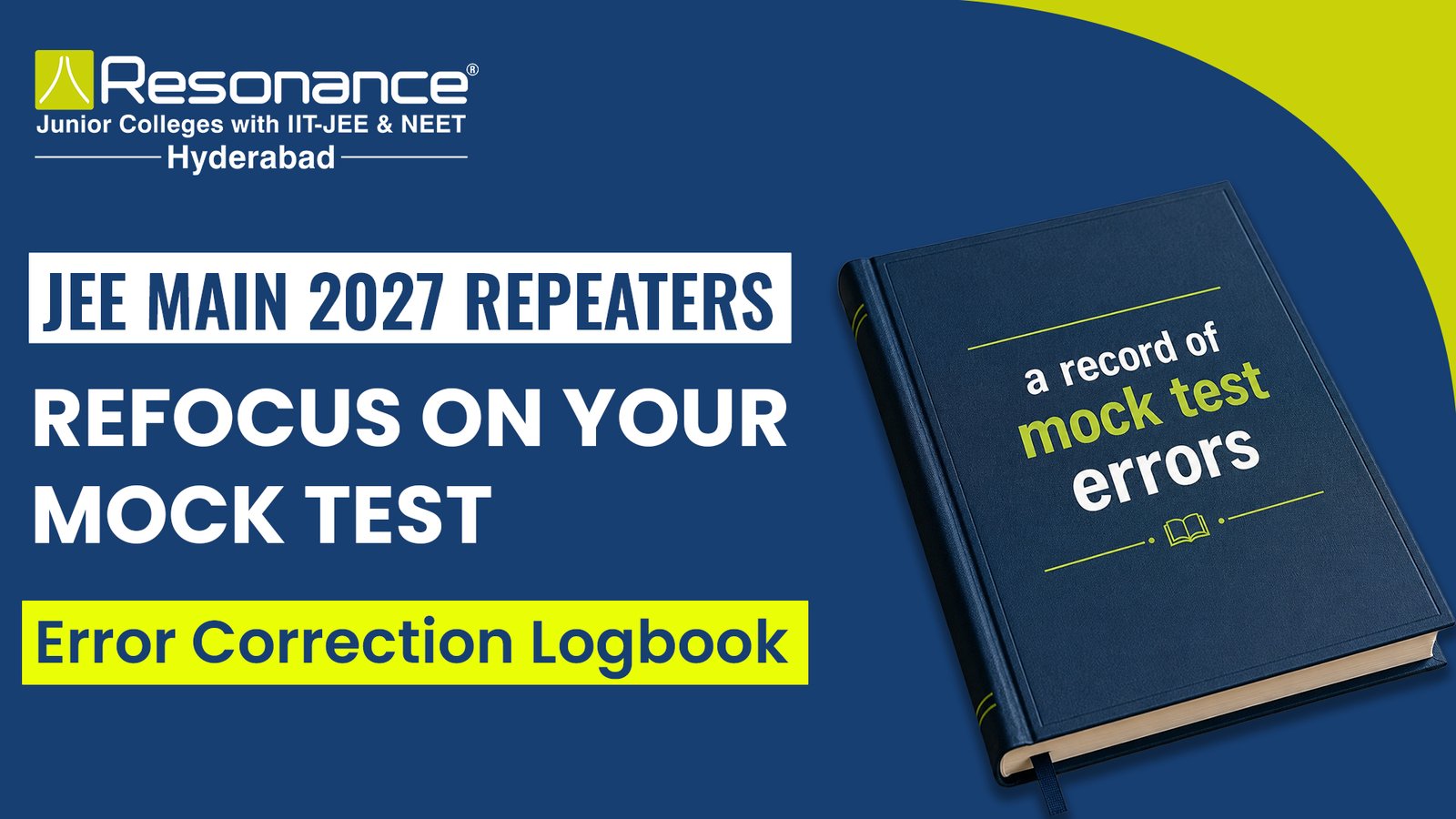
Maintain a logbook that records every single minute error you make in the physics section.
The error may appear silly, but it can still lead to marking wrong answers. Therefore, carefully reviewing the error book can help you reduce mistakes through periodic practice sessions.
Below is an infographic that revolves around the error correction technique:

You shouldn't feel surprised if you are asked to repeat the same error-tracking techniques again and again. It's the only error-correction method that can help you reduce the number of attempts and improve your success rate much earlier. I bring in physics through the conversation to show everyone that if you follow the technique for solving problems, you can avoid slipping and reach greater accuracy in less time. I hope this information is helpful to those who need it right away.




Copyright © 2021 - 2026 RESONANCE HYDERABAD. All rights reserved. Managed by MAIDEN DROP EDU FOUNDATION and MAIDEN DROP EDU FOUNDATION SOCIETY