- September 19, 2026
- by Resonance Colleges
- 6 Views

Synopsis:
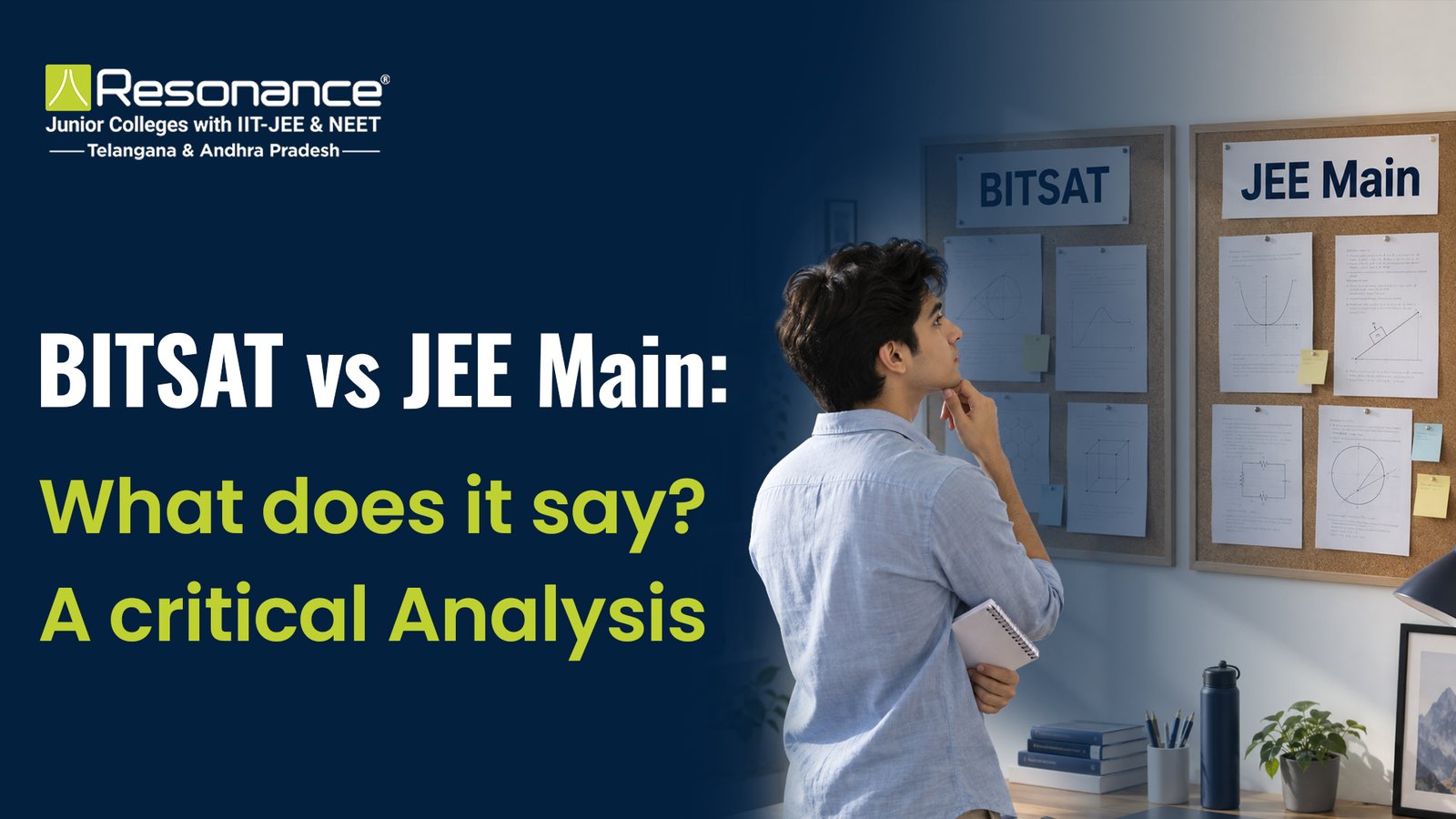
Many engineering aspirants serious about JEE Main preparation also consider BITSAT, and whether to prepare for both simultaneously becomes their biggest doubt. In particular, second-year Intermediate aspirants often feel an immediate urge to prepare for BITSAT. Although it is a national-level competitive exam, you can still take it, provided you address the issue properly.
As you scroll through the content and table, you can see how distinct BITSAT and JEE Main are. Although this episode focuses on the BITSAT vs JEE Main comparison, a careful evaluation can help you understand what factors influence success in BITSAT and JEE Main. Aspirants' success rates depend entirely on the skill sets you build through hard work, dedication, and determination.
Above is the tabulation between the BITSAT & JEE Main Exam
* represents the total number of questions to be answered with no choices in BITSAT examination.
** represents the total number of bonus questions awarded in the BITSAT examination.
By the end of the first year, and in the beginning of the next, an aspirant will have covered at least 70 per cent of the BITSAT syllabus. Strange, is it not? To elaborate, a JEE aspirant needs to complete their PCM syllabus early in their 2nd year of Intermediate. That means 70 per cent of the BITSAT syllabus gets covered. Then, what is left for BITSAT preparation? You may be surprised to find that a 30 per cent gap in the PCM syllabus, when you cover it confidently, can support your interest in taking the BITSAT exam.
In addition, aspirants need to prepare two additional papers that are not time-consuming but are quite logical in their applications. These are English Proficiency and Logical Reasoning, which cover a valuable portion of the exam, as many as 30 questions totalling 90 marks.
As a national-level examination, JEE Main is tough and demands conceptual thinking and, when applicable, logical reasoning. Aspirants build logical analysis through problem-solving in maths, physics, and chemistry; this element also benefits those appearing for BITSAT.
In less time, JEE aspirants can master English proficiency and logical reasoning, and the marks they earn become a cutting edge in building big totals. So, JEE aspirants have a cutting edge.
Another interesting feature of the BITSAT paper is that aspirants who are good at applying formulae and have a good memory can score high.
In BITSAT, speed and accuracy matter most, and the questions do not require deep conceptual thinking.
The questions that appear do not require multi-step problem solving, but demand better time management.
BITSAT 2027 conducts Session 1 & 2 in late May to June and mid-April to May. With this in mind, a JEE Main aspirant can focus on JEE Main, where they reach the crux of conceptual thinking to solve tough problems. As they begin focusing on physics, chemistry, and maths, they lay the foundation for the BITSAT program. Hence, the additional 30 per cent preparation required for physics, chemistry, and maths can be managed, even though the syllabus differs from JEE Main preparation.
Another major advantage for a BITSAT aspirant is the chance to score higher by answering 90 marks of English Proficiency and Logical Thinking without losing accuracy.
In inorganic chemistry and physical chemistry, aspirants are advised to be thorough with NCERT books and read inorganic chemistry to score more marks.
After completing every topic in physics, chemistry, and mathematics, make a formula sheet. Practise formulas daily; this helps you recall instantly without solving the lengthy derivations at that time.
Resonance Institutions' expert faculty creates an effective roadmap for aspirants preparing for English Proficiency & Logical Reasoning.
Aspirants should spend at least 2 to 3 hours per week practising grammar, vocabulary patterns, and spatial reasoning.
During preparation, aspirants should stick to the prescribed timetable to avoid spending too much time on preparation.
In the BITSAT exam, proper time management plays a major role. The aspirant must allot 55 minutes to complete Chemistry, English, and Reasoning, totalling 60 questions.
After that, the aspirant must spend 50 minutes on 30 Physics questions and 70 minutes on 40 Maths questions.
Experts say never attempt unknown questions mindlessly, and never unlock the 12 bonus questions unless one has enough time to attempt them.
The thumb rule is to attempt bonus questions only when the aspirant completes at least 120 questions and has an additional 20 minutes to attempt them.
BITSAT questions are directly related to formula application, and aspirants need to answer the BITSAT question paper quickly.
It tests speed and accuracy and doesn't require deeper conceptual understanding or multiple conceptual problems.
To intensify competition, BITSAT has introduced 12 bonus questions to be attempted within the stipulated 180 minutes.
An aspirant who chooses to answer the bonus questions must complete the 130 questions before attempting the 12 bonus questions.
An aspirant who begins attempting the bonus questions will not be able to reattempt the 130 questions, as they get locked. This clause makes it clear: never attempt the bonus questions until you have completed the 130 questions and have enough time to attempt them.
To prepare for BITSAT, a JEE Main aspirant needs a little additional effort, as 70 per cent of the preparation is completed in JEE Main. What is left?
The JEE aspirant must cover an additional 30 per cent of the syllabus in physics, chemistry, and mathematics. In addition, the aspirant must prepare for English Proficiency and Logical Reasoning questions worth 90 marks. The main difference between preparing for BITSAT and JEE Main is that BITSAT questions don't require deep conceptual understanding; instead, they demand speed and accuracy. BITSAT questions are almost entirely formula-based applications. Therefore, aspirants should spend very little time on them and make few errors, which may be unavoidable.



Copyright © 2021 - 2026 RESONANCE HYDERABAD. All rights reserved. Managed by MAIDEN DROP EDU FOUNDATION and MAIDEN DROP EDU FOUNDATION SOCIETY