- September 22, 2026
- by Resonance Colleges
- 6 Views

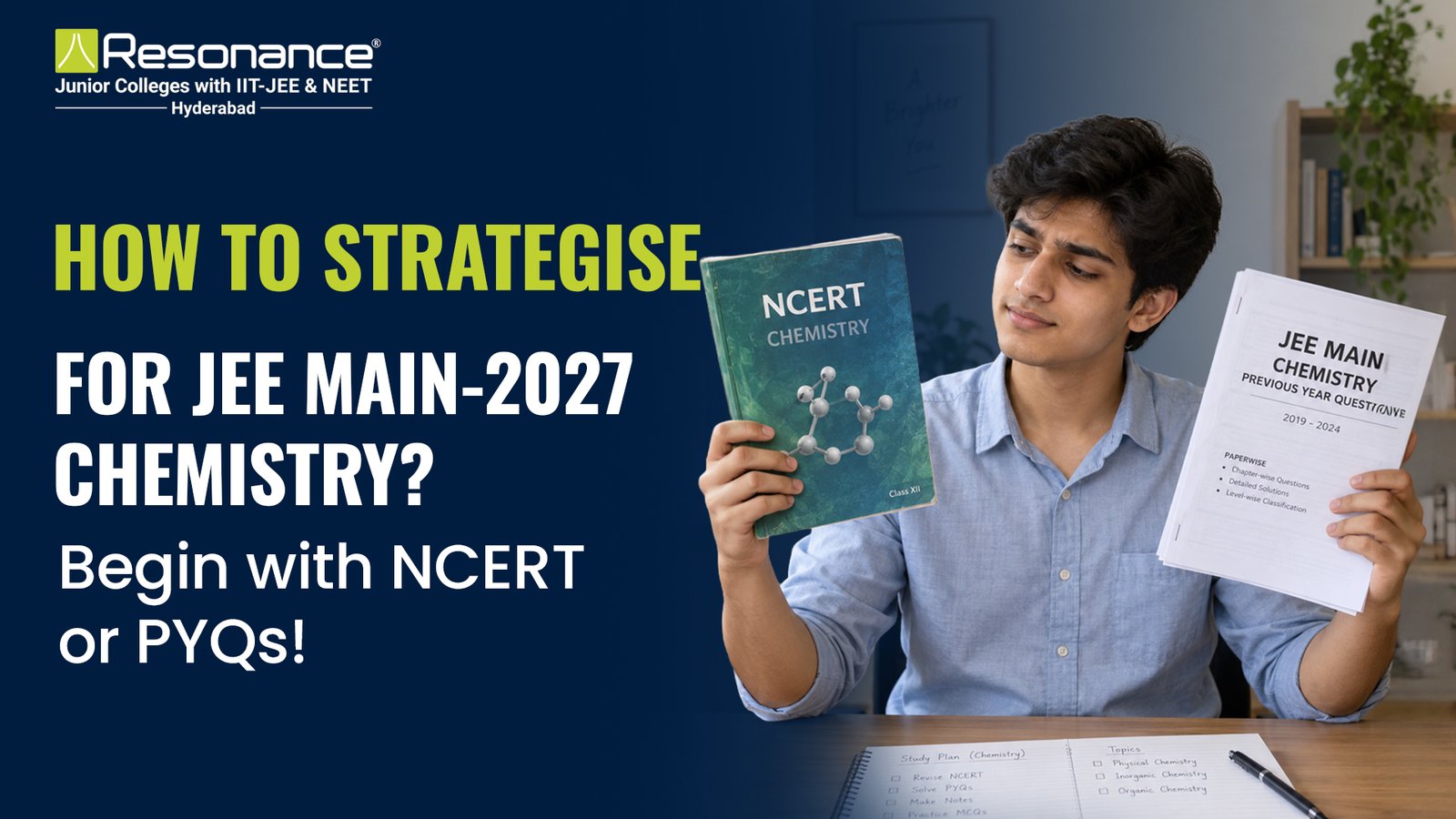
An expert panel from Resonance Institutions in Hyderabad has recommended tested, proven strategies and methodologies that help a JEE Main 2027 aspirant crack this national-level examination. Many students who approach the Resonance help desk for counselling are guided through various aspects of JEE Main preparation, and we are confident that our guidance can deliver the best results in JEE Main 2027. But here's a common doubt most JEE aspirants face: "How do I begin preparing for JEE Main 2027, the most challenging exam at the national level?" Browse the paragraphs, tables, and infographics that explain the best strategy for JEE Main Chemistry more effectively, without wasting time on less significant topics.
Any national-level examination is built on certain basic parameters that define how easy, moderate, or difficult the question paper is to solve. Chemistry in JEE Main is no exception; aspirants must understand the exam pattern thoroughly and follow a specific methodology and strategy.
This episode explains how an aspirant should define and design their follow-up JEE Main Chemistry preparation strategy, especially what to begin with. NCERT Books or PYQs.
An aspirant can find the right answer by following these simple steps, which save time and energy and leave more time for Physics and Mathematics. Remember, time management is the most important factor in scoring high in the exam. To begin with,
JEE Main Chemistry has three sections: physical chemistry, organic chemistry, and inorganic chemistry. Whether you are a beginner, a repeater, or in Class 12, experts have designed a perfect method to follow. Aspirants must focus on the learning process provided on this page to score a high percentile in chemistry.
Here is the thumb rule to follow to score high in the chemistry paper.
Every section in chemistry needs proper attention using the NCERT book to lay a strong foundation.
After learning the material and making references in NCERT, the aspirant should move on to practice previous years' question papers.
Technically, NCERT books are the best national-level books for learning concepts thoroughly. Given the weightage levels, an aspirant can depend on NCERT books for inorganic (80 to 90 per cent), organic (60 to 70 per cent), & physical chemistry ( 30 to 40 per cent)
A tabulation that defines the significance of NCERT Chemistry books & Previous Years Questions
In NCERT,
For inorganic chemistry, the aspirant must read the NCERT books line by line. Later, practice the last 10 years' JEE Main Chemistry question papers.
For organic chemistry, the aspirant must focus on reactions & mechanisms. Later, practice the chapter-wise question papers.
For physical chemistry, the aspirant must build formulas and concepts by repeatedly revising NCERT Chemistry books. Later, practice all available question papers seriously.
As Resonites Progress through the learning process at Resonance Junior College campus, Resonance experts conduct intensive research to deliver the most important study material. These materials carry high weightage because they appear frequently in previous years' question papers. This means the entire JEE Main Chemistry exam paper is thoroughly analysed and shared with resonites for condensed study to improve percentiles. However, here are the important high-weightage topics in inorganic, organic, and physical chemistry that align with NCERT Exemplar questions. A similar approach is levelled for JEE Main 2027 physics, so that aspirants can gain meaningful information.

In organic chemistry, JEE Main 2027 aspirants can expect tricky, conceptual questions. Aspirants must focus on Coordination Compounds, d- & f-block elements, and chemical bonding.
NCERT Exemplar covers multi-step reactions and acidity & basicity ranking problems. Aspirants must focus on Aldehydes, ketones, carboxylic acids, GOC, & Amines.
The Resonance faculty guides students through assertion-reason and multiple-correct-type questions that build strong numerical intuition. Aspirants must focus on Electrochemistry, Equilibrium, & Chemical Kinetics.
The paragraphs above outline a JEE Main Chemistry study plan for droppers and Class 12 students, presented in this pattern. Before attempting mock tests, aspirants must master concepts and analytics to solve complex problems, yet many skip this step in their anxiety to finish preparations. This is a reminder to aspirants not to forget to master the NCERT chemistry books, without which it is impossible to score high marks in JEE Main Chemistry. However, we would like to leave the page by highlighting the essence of NCERT Exemplar problems, the main nerve cell of preparation.
The Department of Education in Science and Mathematics is a specialised division of the National Council of Educational Research and Training (NCERT) that designs and compiles the NCERT Exemplar. From NCERT Exemplar problems, an aspirant can develop higher-order thinking and problem-solving skills. In this issue, Resonance Junior Colleges teach nothing less, as every resonite will learn concept applications and get the opportunity to practice the toughest mock test papers without doubt or enquiry. Resonites take the toughest mock tests to master the JEE Main Chemistry exam and, overall, score a high percentile. Hurry up! Visit Resonance's long-term program to get the most benefit.


Copyright © 2021 - 2026 RESONANCE HYDERABAD. All rights reserved. Managed by MAIDEN DROP EDU FOUNDATION and MAIDEN DROP EDU FOUNDATION SOCIETY