- January 22, 2026
- by Resonance Colleges
- 1317 Views

Synopsis:
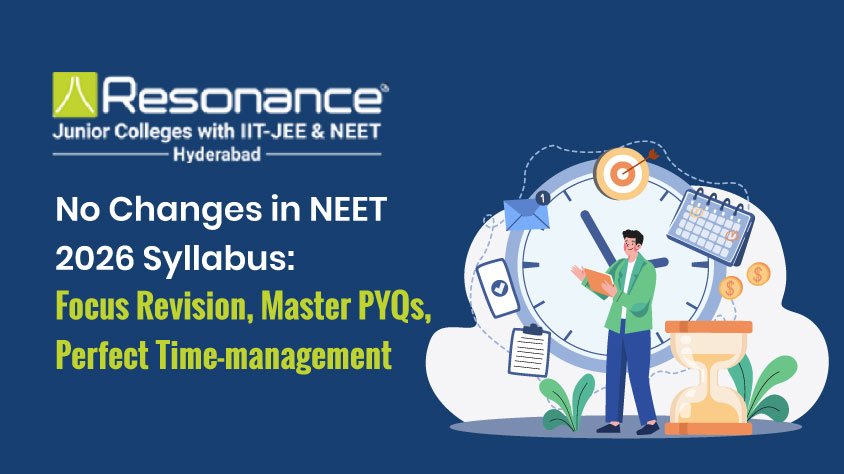
Changes to the NEET exam syllabus and pattern usually jolt aspirants' preparation, as new topics need to be read and deletions made thereafter. It involves extensive fresh analysis of preparations, and these become more complex as the exam pattern changes. However, aspirants appearing for NEET 2026 will not face such scenarios, as the syllabus and exam pattern this year remain the same as in 2025. Still, aspirants will need to put in proper time, make thorough revisions, and practice PYQs. But to do so, smoothly, is what the upcoming paragraphs express.
On 25, December, 2025, the NEET 2026 syllabus was released, drawing the attention of the entire section that would participate in the medical entrance exam nationwide in 2026. Almost all NEET aspirants began to skim through the syllabus published by NMC as regulated by the NTA, the national testing agency, and not surprisingly, on comparison, observations say that the 2026 syllabus remained the same with no modifications, which usually include or exclude topics or subtopics in the subjects of NEET's interest. It meant a direct signal to NEET aspirants not to make any changes to their preparatory schedule, but to maintain a continued focus in depth, master PYQs, and perfect time management, rather than concentrate on newer topics in subjects. Further, in a broader sense, the NEET paper syllabus is entirely dependent on the NEET Core Concepts derived from its books in Physics, Chemistry, and Biology. The lines explain how to manage the core NCERT concepts with the subject extension to good reference books. While preparing for the NEET 2026 exam, which comprises huge volumes of information that require smart work alongside consistent hard work.

Another essential issue every aspirant must know is the exam pattern: it is stable, same as the previous years, which means the accuracy and speed you established through practice of previous years' exams haven't been wasted. Now, it will not require any new strategies to design or develop to solve the mock tests, as they can continue on similar lines. For the reader's knowledge, the exam pattern shall cover 180 compulsory MCQs and a maximum of 720 marks. The exam paper duration is 3 hours, and the distribution of marks will be as follows: Physics (45), Chemistry (45), & Biology (90).
Experts decide on high-weightage topics through a practical analysis of the available data from previous years. The expert faculty, with different subject backgrounds, have been mapping question papers for at least 15 years. Questions are indexed by chapter, concept, and difficulty. The questions are selected based on their repetitiveness and the level of frequently twisted ideas. Such questions are compared and graded based on NCERT concepts and the question trends observed in the NTA paper. The experts outline the core topics that need to be mastered, as well as the easy-scoring topics that serve as support in the main examination. From it, one thing is sure: an expert drives the high-weightage topics that are data-driven outcomes, not predictive ones.
A well-experienced expert would formulate high-weightage topics thoughtfully, not through wild guesses. These topics span various subjects and have repetition across 8 to 10 years. Topics with high concept density are more likely to be chosen for study, such as a single idea that leads to many questions. For instance, in a broader context, high-yield areas for physics, chemistry, and biology are listed below.
Physics:
Mechanics (basics), Current Electricity, Magnetism, Modern Physics
Chemistry:
Thermodynamics, Electrochemistry, Coordination Compounds, Biomolecules
Biology:
Human Physiology, Genetics, Ecology, Biotechnology
An aspirant must adopt a practical method that enables them to save time during the main exams. They must select one concept, thoroughly explain it to themselves, and begin answering PYQs and conducting error analysis thereafter. Remember, an aspirant must not cross the level of understanding required to solve the question papers. Experts advise against taking on problems related to JEE Advanced, as it may lead you into a trap. Always carry an error notebook to identify and keep filling it. You must answer questions within a time limit, such as 30 questions in 45 minutes.
Every week, an aspirant must consider two high-weightage topics and complete them before moving on to the next topic. Be mindful of revising the previous topics at least 3 times. An aspirant must always engage in active recall of the topic, not just repetitive reading.
Summary:
Whenever there is a change in the exam syllabus, an aspirant will have to adjust their preparation strategies; Otherwise, they will not be able to meet their expectations. However, it is important to select the right high-weightage topics and thoroughly revise for the final exams.
The aspirant shall have to change the preparation mode and adopt the newer strategies to score high in NEET examinations.
Time management can help an aspirant revise better and further enable them to attempt questions confidently and consciously in the main examination.
The high-weightage topics are most likely to come in the main examinations. These high-weightage topics are most repetitive year after year and are concept-oriented, which can lead to multiple questions.



Copyright © 2021 - 2026 RESONANCE HYDERABAD. All rights reserved. Managed by MAIDEN DROP EDU FOUNDATION and MAIDEN DROP EDU FOUNDATION SOCIETY