- November 24, 2025
- by Resonance Colleges
- 677 Views


The journey to cracking the Joint Entrance Examination (JEE) Main is challenging, and a solid preparation strategy is only half the battle. The real key to success lies in a smart, efficient JEE Main 2026 revision strategy. Resonance JEE Main toppers' tips you may want to consider are:
Start by making short notes from long notes. In those, write only the points that you might forget or the ones that help you recall the full concept easily, like using arrows, flowcharts, or even memes to remember better! If a chapter has too many formulas, make a separate formula sheet for it. The lecture notes and videos not only have theory and key ideas but also formulas.
It’s not just about putting in more hours, but about adopting a structured & active-recall-based approach.
This is one of my most useful and well-thought-out methods. JEE Main 2026 revision strategy isn’t like school revision, where you study everything again in the last week and hope it stays in your head. Here, we need techniques like spaced repetition, that is, revising again and again at smart intervals.
For this, we’ll use two kinds of short notes: 1. Short Notes – chapter summaries, 2. Daily Short Notes – notes you make on the same day after studying a topic. For example, let’s say you studied Carbonisation in Chemical Bonding today. When you get home, write down:
Short notes on that topic
Questions you solved on the same
Headings for every main point
These become your Daily Short Notes. Then you read the chapter again on your own. Once you finish the full chapter, make complete short notes.
1 day after the lecturer teaches, revise it again. Then, 4 days later, start with your own studying of the same chapter. 9 days later, read together short notes & daily notes. Repeat after a month. This way, you’ll end up revising the same chapter 7–10 times before JEE, and by then, you’ll know it like the back of your hand.
Don’t focus too much on Maths, or you’ll end up ignoring the basics of other subjects. Don’t hesitate to ask doubts in class, thinking they were silly. The mentors/lecturers at Resonance give the best revision plan for JEE Main. So they’ll be there for you at every step to assist. Try to do more mental calculations and avoid the calculator. This increases your mental speed. Don’t skip mock tests & it’s analysis. Solve problems by also keeping a watch on time & accuracy, so that on exam day you don’t underperform.
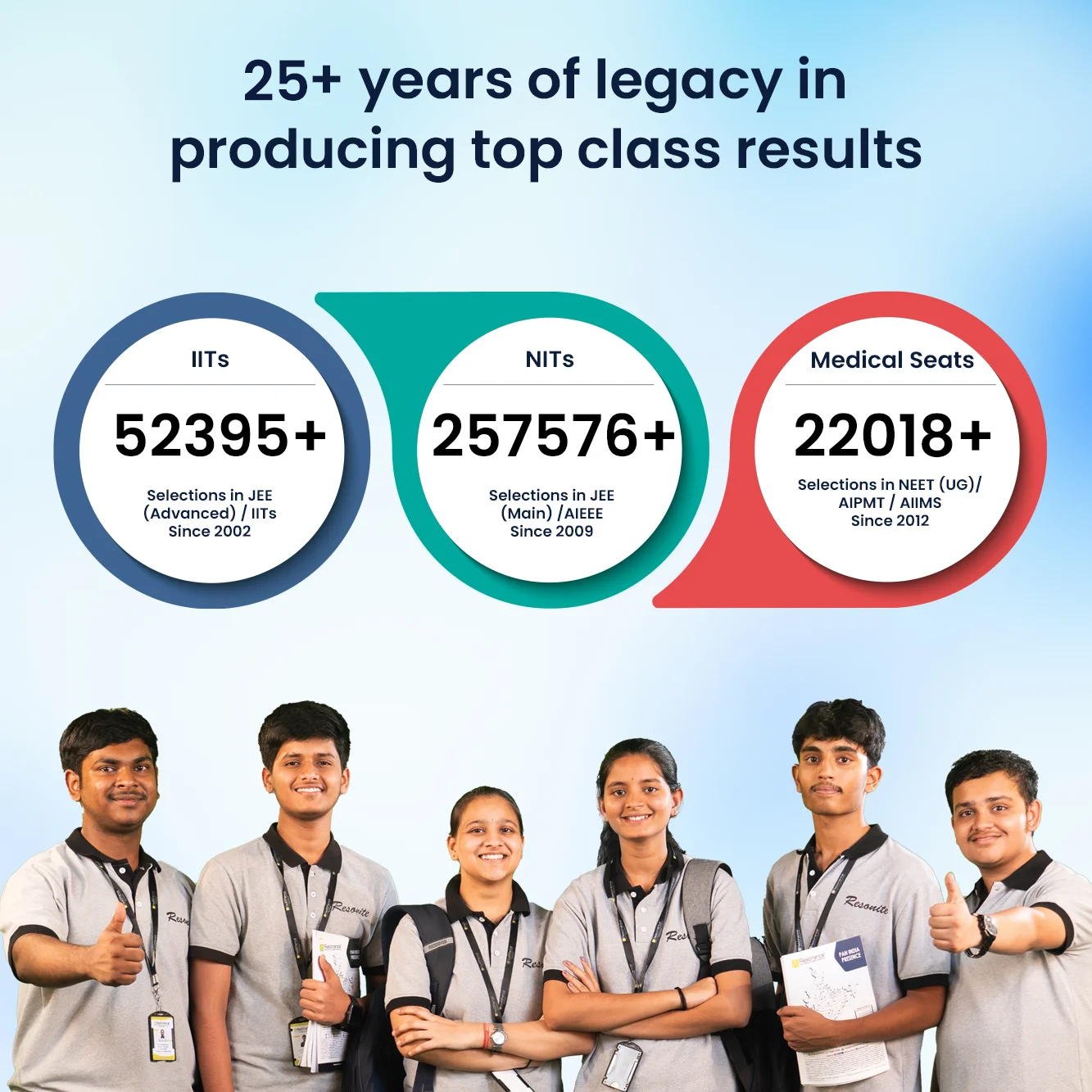
These are some of the JEE Main toppers' tips. These are quite common among Resonites who are in full swing with their JEE Main study plan 2026. The mentors at Resonance Colleges constantly keep their students motivated and focused every single day. In fact, the success of 3 out of 4 students securing top ranks in JEE Main and JEE Advanced clearly reflects the result of their consistent and dedicated revision efforts.
Most toppers start their serious revision about 3 to 4 months before JEE Main. But light revision actually begins much earlier, after every chapter or test. Small daily revisions make the final months much smoother.
Toppers follow a fixed daily routine, 6–8 hours of focused study with short breaks. They divide time between concept revision, practice tests, and analysing mistakes. Evening hours are often used for light revision or mock test review.
Most toppers make short notes or formula sheets for every subject. These notes include key concepts, shortcuts, and common errors. During the final days, they revise only these sheets instead of heavy textbooks.
During the last 2 months, toppers take one full-length mock test every 3–4 days. This helps improve speed, accuracy, and time management. After each test, they spend time analysing their mistakes.
It’s completely normal. Toppers also forget, but they revise in small chunks, use memory aids like charts or flow diagrams, and regularly revisit tough topics. The secret is consistency, not perfection.



Copyright © 2021 - 2026 RESONANCE HYDERABAD. All rights reserved. Managed by MAIDEN DROP EDU FOUNDATION and MAIDEN DROP EDU FOUNDATION SOCIETY