- November 05, 2025
- by Resonance Colleges
- 1972 Views

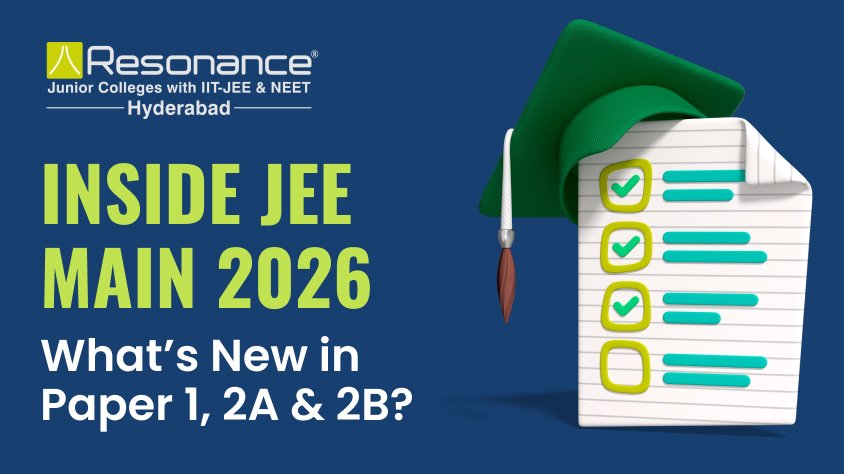
The Joint Entrance Examination (JEE Main) 2026, conducted by the National Testing Agency (NTA), serves as the gateway to India’s premier engineering and architecture institutions, including NITs, IIITs, and CFTIs and as the eligibility test for JEE Advanced, which leads to the IITs.
With registrations open from October 31 to November 27, 2025, and the Session 1 exam scheduled from January 21 to 30, 2026, aspirants are in the midst of an important preparation phase. Understanding the exam structure is the first step to building a clear strategy for success.
JEE Main 2026 comprises two papers designed for different disciplines:
Each paper follows a computer-based test (CBT) format, except for the Drawing Test in Paper 2A, which will be conducted in offline (pen and paper) mode.
Paper 1 is the most common among aspirants and focuses on Physics, Chemistry, and Mathematics.
Each subject has two sections:
The total comes to 75 questions, carrying 300 marks. The marking scheme remains the same as in previous years, +4 for correct answers and -1 for incorrect responses (in both sections).
The exam will be held in two shifts daily, from 9:00 AM to 12:00 Noon and 3:00 PM to 6:00 PM, allowing candidates flexibility in scheduling.
This paper is designed for architecture aspirants. It evaluates analytical, visual, and creative abilities through three parts:
The total marks for Paper 2A are 400.
Paper 2B tests planning aptitude and logical reasoning skills. It includes:
This paper is conducted entirely online (CBT mode) and carries 400 marks in total.
The JEE Main 2026 will be available in 13 languages, including English, Hindi, Telugu, Tamil, and others, ensuring inclusivity for students across regions.The NTA has also introduced assistive digital tools for PwD candidates, such as zoom, magnifier, and dark mode options, to enhance accessibility.
A clarification from the NTA confirms that no calculator (onscreen or otherwise) will be allowed during the exam, candidates must rely on conceptual clarity and mental calculations.

Engineering aspirants should register for Paper 1 (B.E./B.Tech).
Those inclined toward design and architecture should opt for Paper 2A (B.Arch).
Candidates interested in urban and regional planning may go for Paper 2B (B.Planning).
Each paper requires a tailored preparation strategy. Familiarity with mock tests, numerical-type question practice, and a balanced approach across subjects can significantly boost performance.
As the JEE Main 2026 approaches, clarity about the exam structure helps students plan smarter and perform better. Along with understanding patterns, students should also focus on conceptual learning and consistent practice.
At Resonance Hyderabad, our academic programs are structured around the very essence of this exam, building strong fundamentals, analytical thinking, and test readiness. With expert mentoring and proven methodology, we help every student approach JEE Main with confidence, clarity, and consistency.
Because in the journey to engineering excellence, the right foundation makes all the difference.

Copyright © 2021 - 2026 RESONANCE HYDERABAD. All rights reserved. Managed by MAIDEN DROP EDU FOUNDATION and MAIDEN DROP EDU FOUNDATION SOCIETY